Your team build plan used to be simple: raise money, hire people, fill seats. That version is dead. Today a solo founder with AI agents can cover support, outreach, and content before making a first hire.
The question in front of you has changed. Who to hire still matters, but it comes second now. First you decide which roles to automate, and which ones truly need a human.
Getting it wrong costs you twice. Automate work that needs judgment and you burn customer trust. Hire for work an agent could handle and you burn runway you don't have.
This post gives you a sequence to test, not a rule to follow. You'll get the five functions to hand to AI first, the roles that should stay human, the cost math behind each choice, and a twelve-month rollout you can adapt to your own bottleneck.
The numbers below assume an early-stage team: you, maybe a cofounder, and no dedicated ops hire yet. Past that stage, the same filter applies. Your numbers are just bigger.
One rule drives the whole team build plan
Early hiring advice converges on one idea: hire against your binding constraint. A founder's guide to the first ten hires from HSG puts it plainly. The signal to hire is a specific, measurable bottleneck that a person would remove. Hiring on a vague sense of being busy burns runway.
Automation deserves the same test. Automate the function that eats founder hours and follows a pattern. Keep humans where the work needs judgment, trust, or taste.
That leaves a simple filter for every role. Automate first when the work is repetitive, high-volume, and pattern-based. Hire first when it needs judgment, creativity, or relationships. Everything in the rest of this plan follows from that one distinction.
The five roles to automate first
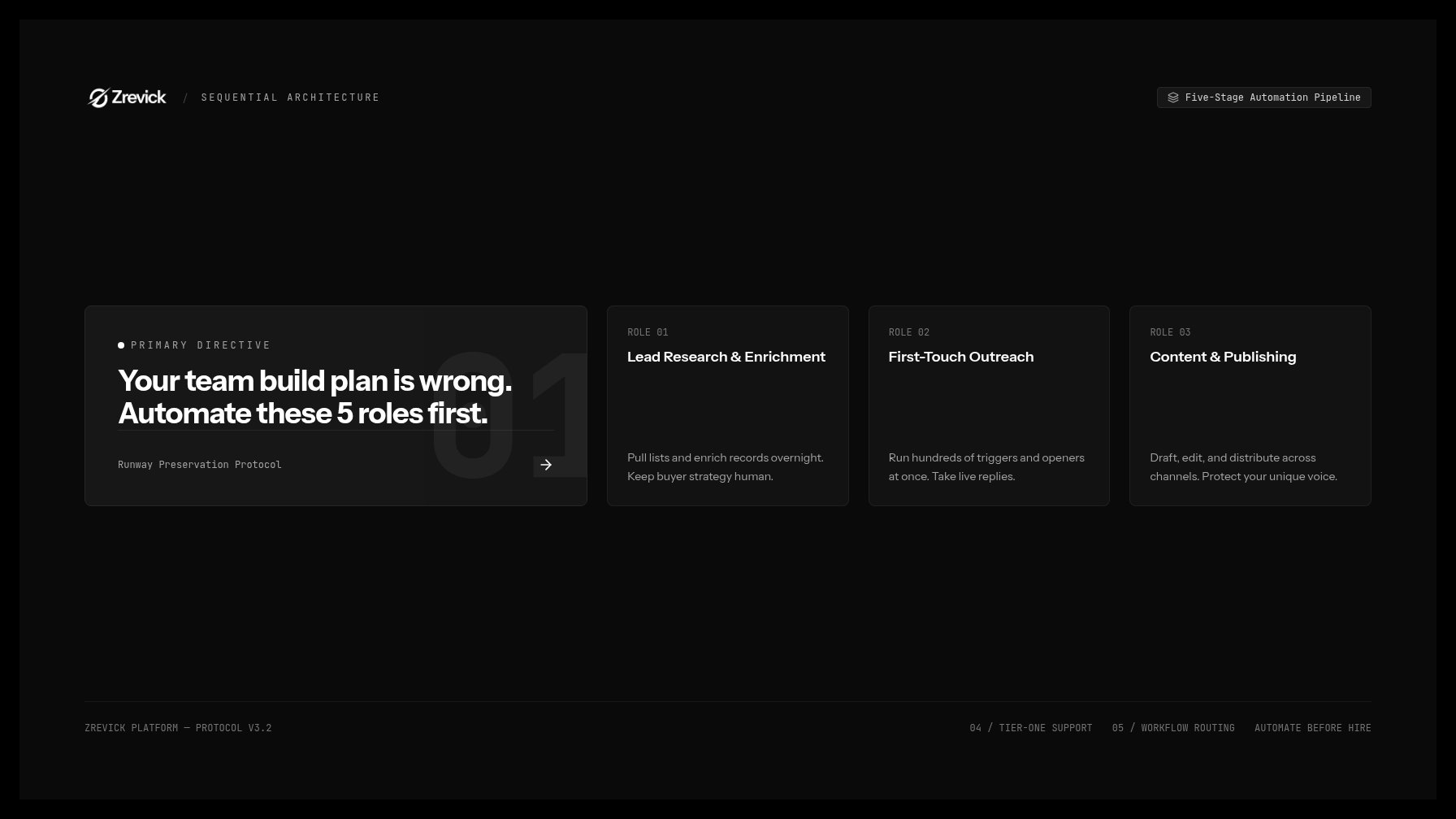
These are the five roles to automate first in your team build plan. Each one eats founder hours, follows a pattern, and frees you for work that genuinely needs a human.
1. Lead research and enrichment
Finding buyers and filling in their details is volume work, and it follows a pattern. An agent can pull a list, enrich records, and flag the best fits overnight. The human part is strategy: choosing the segment and the message. That stays with you.
2. First-touch outreach
Prospecting is mostly pattern. Find a trigger, write a relevant opener, follow up on schedule. An AI-SDR can run hundreds of these at once across email and LinkedIn.
The human part is the reply. When a real buyer answers, you take the conversation.
3. Content and publishing
Drafting, editing, publishing, and distribution are workflow steps now. An agent can turn a support thread into a blog post or a changelog into a launch note.
The human part is the voice. AI can carry your voice once you define it. It can't decide what you stand for.
4. Tier-one support
Most early tickets repeat. Setup questions, billing questions, how-do-I questions. An agent can answer those, route the rest, and summarize every thread.
The human part is escalation. Angry customers and churn risks need a person, fast.
5. Operations and CRM admin
This is the quiet time sink in a two-person company. Data entry, pipeline updates, meeting notes, reminders. None of it is hard, and all of it goes undone while you ship.
An agent can log every touch and keep records current. Clean data now makes every later hire more effective.
The roles that stay human
Some functions don't automate well at this stage, and no team build plan should hand them to agents yet:
- Closing key deals. Big buyers purchase trust, and that's a human job.
- Product judgment. Deciding what to build and what to cut is your core work.
- Brand and positioning. Taste doesn't follow a pattern.
- Hiring and culture. Stay in the room for culture-fit screens. HSG flags delegating that judgment as a common source of mis-hires.
The bar per hire keeps rising, too. HSG notes that as founders lean on AI for work that once needed headcount, investors weigh revenue per employee over rapid hiring. In a smaller team, every seat carries more weight.
So hire slowly, and hire great. McKinsey research, cited by HSG, found that top performers in critical roles deliver 800 percent more productivity than average ones. HSG also favors generalists over specialists early, because everyone has to shift as the roadmap moves.
The cost math: automate versus hire
This is illustrative math for your team build plan. Plug in your own figures.
Say a fully loaded operations hire costs $120,000 a year in your market. That's $10,000 a month, plus onboarding time. Gallup, as cited by HSG, puts the cost of replacing a single employee at one-half to two times their annual salary. On a $120,000 salary, a failed hire can cost $60,000 to $240,000 to unwind.
Now compare software. Zrevick's Starter plan runs about $34 a month billed annually, with a baseline allowance of roughly 10,000 leads. That's about $408 a year for outreach, content, support, sites, and CRM in one workspace.
Software doesn't replace people. But the automation layer costs a rounding error next to a single salary. Automate the pattern work, measure the gap that remains, then hire against that gap.
Two caveats. Automation needs setup and a human review layer. And a process you've never run manually is a poor automation candidate, so run it once yourself first. If you have no data on a function, that's not evidence it needs a human. Run it manually for two weeks and find out.
Sequencing mistakes to avoid
HSG's early-hiring traps map cleanly onto automation choices, and any one of them can sink an otherwise sound team build plan:
- Copying a template. Another company's org chart fills seats and leaves your bottleneck in place. The same goes for copying their AI stack.
- Hiring to relieve anxiety. Seats make a company feel real. They don't remove the constraint.
- Splurging on a senior title early. A pricey VP of Growth before product-market fit usually loses to a hands-on generalist.
- Scaling before the process repeats. Specialists and heavy automation both fail on a process that isn't repeatable yet.
- Skipping a working trial. When you do hire, a paid trial beats any interview loop.
- Under-granting equity. Early employees take risk for below-market cash. Ownership is the trade.
One trap shows up later. Aaron Dinin observes that first employees usually turn out great, while the same startups struggle with hires ten through twenty. Keep the rigor you had at hire one.
A sample twelve-month sequence
Here's a sample twelve-month team build plan to test. Reorder it around your own constraint.
- In months 0 through 3, handle support and sales calls yourself. Automate CRM admin first, so your data is clean from day one.
- In months 3 through 6, turn on automated outreach and content. You take replies and calls.
- In months 6 through 9, review the gap. Whatever still eats founder time is now visible in data, not vibes. Make your first hire against that gap, and favor a generalist.
- By months 9 through 12, split the work: agents on volume, people on judgment.
Where Zrevick fits
Most teams stitch together five to eight tools: a website builder, a CRM, a lead database, a sequencer, a CMS, a support desk. Each one adds cost. Worse, each one creates a data silo.
Zrevick replaces that stack with one connected workspace:
- Every email, LinkedIn message, meeting, and document rolls into a single living profile through one Identity Graph. Humans and agents work from the same picture.
- MCP and REST APIs let you drive outreach, publishing, and support from tools you already use, like Claude Code or Codex.
- Support tickets and sales replies feed back into outreach. Each cycle starts smarter than the last.
- Every tier includes unlimited workspaces, seats, and AI agents. Adding headcount never means adding tools.
The bottom line
The old team build plan was about filling seats. The modern one starts with automation, not headcount. Hand lead research, outreach, content, support, and ops to agents first. Keep humans on closing, product, brand, and hiring. Then make your first hire against whatever constraint remains, with the same rigor you had on day one.
If you're weighing a hire against an agent for your next role, Zrevick covers the automate-first layer in one workspace. You can run that layer for about $34 a month before you ever write a job description.