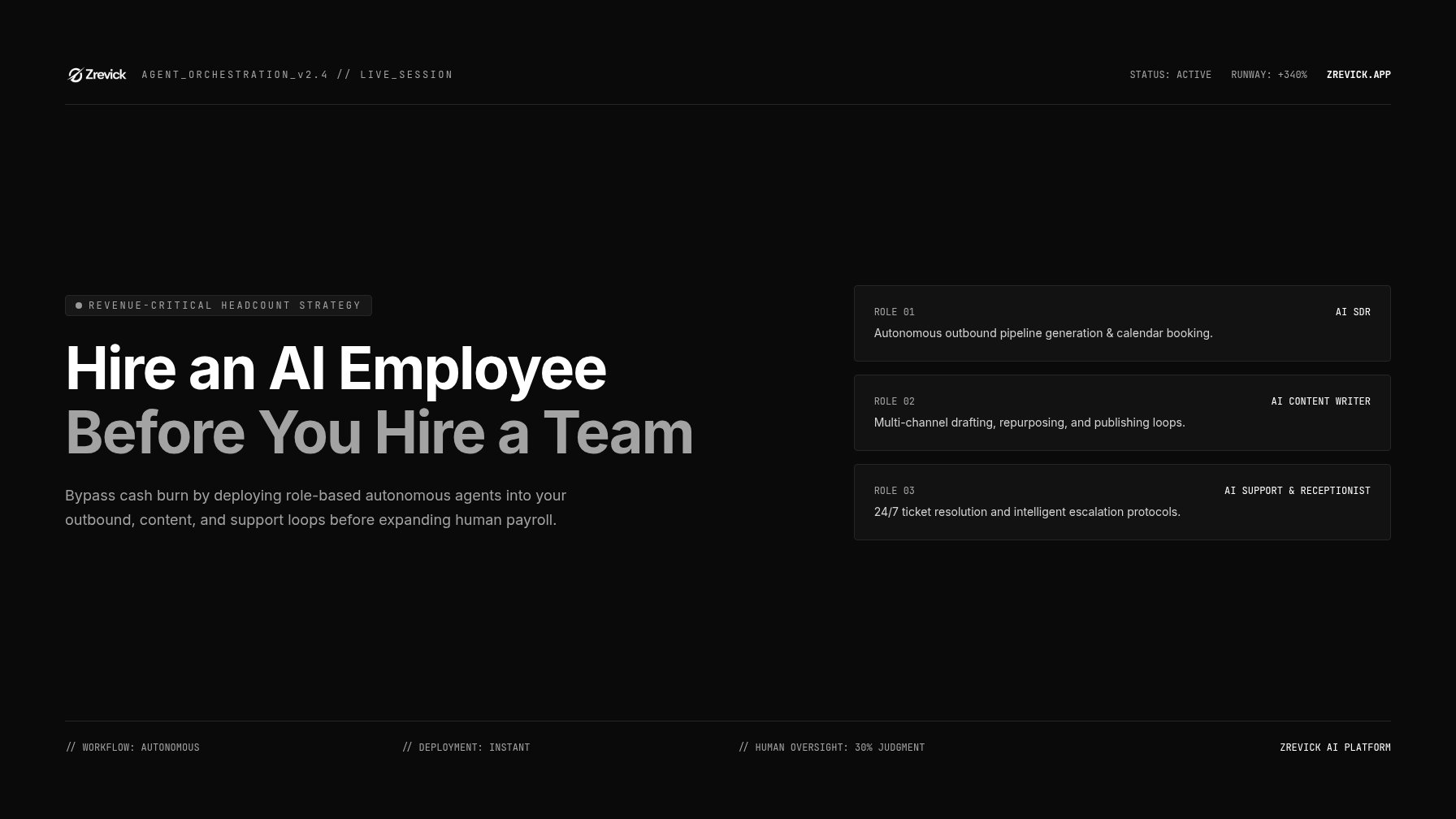
An AI employee gives you output before payroll gives you headcount. If you're a solo founder, you've heard the standard advice: hire fast, hire senior. But payroll burns the cash runway you're trying to stretch. So flip the sequence. Fill your revenue-critical roles with AI first, then hire humans where they create the most value.
This isn't another "future of work" think piece. It's a hiring guide. You'll get an org chart, an onboarding checklist, per-role metrics, and honest cost math.
What an AI employee is (and what it isn't)
So what is an AI employee, exactly? It's a role-based AI agent with a job description, tool access, and its own metrics. It doesn't just answer questions. It does the work end to end.
Compare the two. A chatbot tells a visitor your pricing tiers. An AI SDR researches that visitor, drafts a follow-up, sends it, and logs the thread in your CRM.
What it isn't matters just as much.
- It's not a dumb bot. It works inside guardrails and escalates when it's unsure.
- It's not a strategist. It runs the playbook you write. You still own positioning, pricing, and product.
- It's not a human replacement. It handles the repeatable 70% so you can handle the judgment-heavy 30%.
Picture a junior hire who never sleeps, never forgets, and reads every document you give it. That's what AI employees for business really are: named agents with roles and goals, not one floating chat window.
The revenue roles: your first four AI hires
Your first human hire shouldn't be a salesperson, a writer, or a receptionist. Those jobs are repeatable, language-based, and metric-driven. That makes them perfect for AI. Here's the solo founder's org chart.
1. AI SDR. It researches prospects, personalizes outbound, follows up, and books meetings straight into your calendar. It works the lead list while you sleep. Metric: qualified meetings booked per week.
2. AI content writer. It drafts blog posts, then repurposes them into LinkedIn posts, newsletters, and sales snippets. You edit for voice and judgment. Metric: pieces published and the traffic they earn.
3. AI support agent. It answers tickets, resolves common issues, and escalates edge cases with full context attached. Metric: resolution rate and first-response time.
4. AI receptionist. It answers every call, books appointments, takes messages, and captures after-hours leads. Metric: calls answered and appointments booked.
Which roles can AI employees fill? Run a simple test. If the work is mostly language, mostly repeatable, and measurable, hand it to AI. If it hinges on trust, negotiation, or taste, keep it human for now.
Onboarding an AI employee: the four-step checklist
When you hire an AI employee, run onboarding like you would for a person. The checklist is the same. The timeline is days, not weeks.
Step 1: Context. Give it your product docs, pricing, ideal customer profile, tone-of-voice guide, and top 20 FAQs. Agents are only as good as what they know. A vague brief gets you vague output. Same as with people.
Step 2: Tool access. Connect the CRM, inbox, calendar, help desk, and website. Grant the least access each role needs. Your SDR doesn't need your accounting software.
Step 3: Guardrails. Write down what it must never do: offer discounts, promise unreleased features, or give legal advice. Then set escalation rules. Angry customers and deals above your threshold go straight to you.
Step 4: Success criteria. Define one metric per role before launch. "Help with sales" is not a job description. "Book eight qualified meetings a month" is.
Most teams skip step four. Then they blame the AI when results disappoint. Don't skip it.
Managing performance: one metric per role
How do you manage an AI employee's performance? With the same discipline you'd use for a person: one owner, one metric, one review cadence.
| Role | Primary metric | Health check |
|---|---|---|
| AI SDR | Meetings booked | Reply rate on outbound |
| AI content writer | Pieces published | Organic traffic earned |
| AI support agent | Resolution rate | First-response time |
| AI receptionist | Appointments booked | Calls answered |
Review weekly. Read transcripts the way a sales manager reviews call recordings. Weak output usually means weak coaching. Sharpen the context, adjust the guardrails, and tighten the target.
Coaching a human takes months to show results. Coaching an AI employee shows up the same day. That's the whole trick: manage the inputs, measure the outputs, iterate weekly.
Cost math: AI employee vs. contractor vs. first hire
How much does an AI employee cost? Line it up against the alternatives for the same role.
A first hire. A full-time U.S. customer service rep earns a median of about $39,000 a year, per the Bureau of Labor Statistics. A receptionist earns about $36,000, per BLS data. A writer earns roughly $73,000, per the BLS. A common rule of thumb: add 25–40% for benefits, taxes, and tools. Your first hire costs $45,000–$100,000 a year, fully loaded.
A contractor. Freelance writers commonly charge $50–$150 an hour. Agency SDR retainers often start at $2,000–$4,000 a month. Contractors flex with demand, but the meter never stops running.
An AI employee. An AI workforce platform like Zrevick prices per role, per month. Expect a flat subscription, a fraction of a salary rather than a multiple of one. You're not paying benefits, payroll tax, or recruiting fees.
The breakeven math is fast. Say an AI SDR books four meetings a month, and each meeting is worth $500 in pipeline. That role pays for itself before your first human paycheck clears.
This isn't AI versus people. It's sequencing. AI employees handle volume; humans handle judgment. McKinsey's State of AI research finds most organizations now use AI in at least one business function. The founders who win start where the math is obvious.
Start with one role
Don't build a team on day one. Build an org chart instead. Give the repetitive, measurable roles to AI employees. Keep the judgment roles for yourself. Then make your first human hire from a position of strength.
Pick one role this week. Most founders start with the SDR or the receptionist. Write its job description this afternoon, and an AI workforce platform like Zrevick can have it onboarded by Friday. The team you build after that will be smaller, sharper, and far cheaper to assemble.