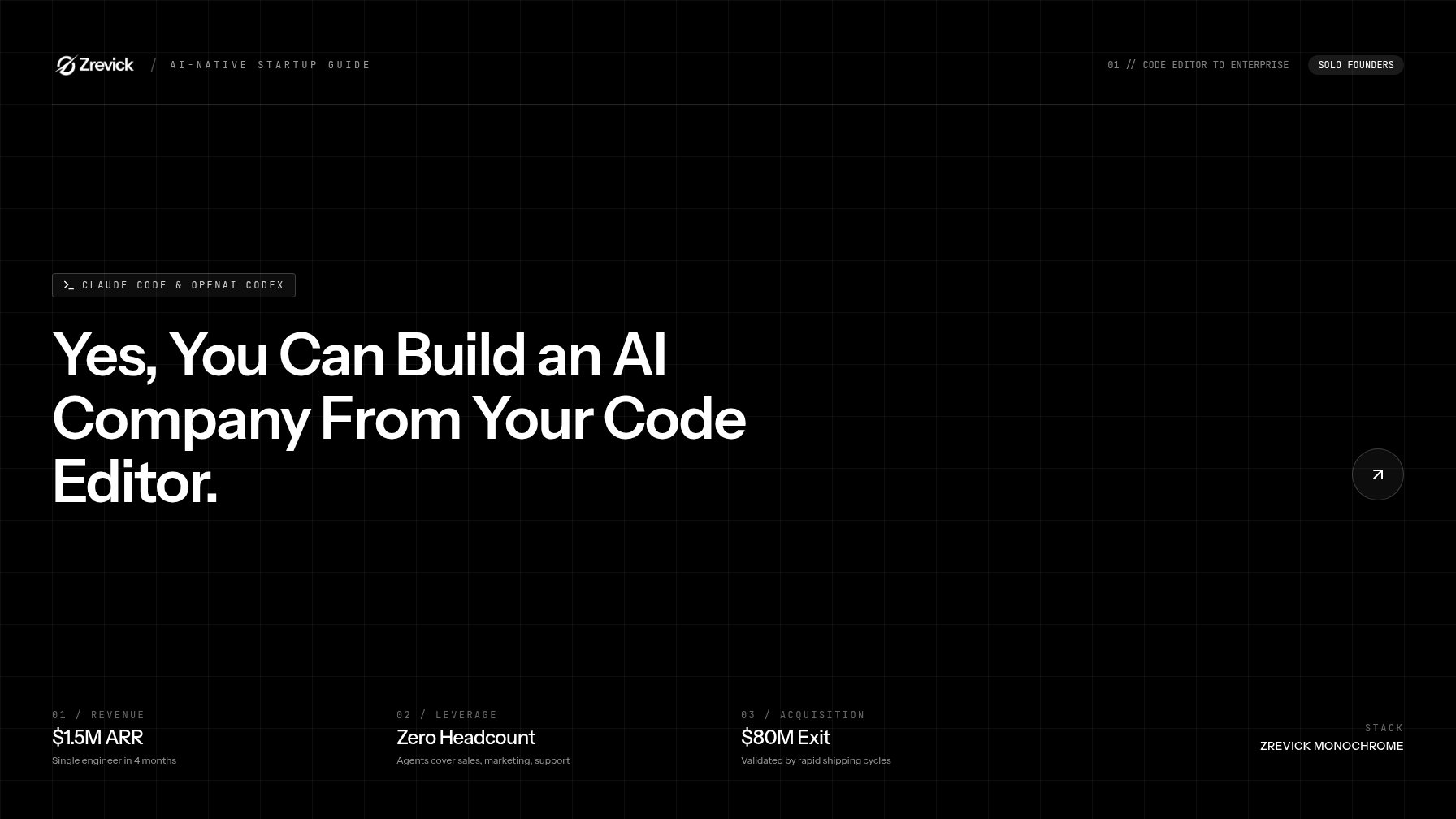
Can one engineer build a real AI company? Increasingly, yes. AI coding assistants collapsed the cost of building product. A quieter shift is happening on the business side. Agents and unified platforms can now cover sales, marketing, and support end to end.
This guide walks the full arc of building an AI company: shipping, positioning, first customers, and the operational stack. Treat each recommendation as a starting point. Test it against your own market.
Why a one-person AI company is now credible
Headcount at young companies has been falling for two decades. J.P. Eggers, a professor at NYU Stern, describes the shift: a one-year-old company averaged seven to nine people 15 or 20 years ago. Recently, that figure was three or four (Fortune).
AI compresses the trend further. Maor Shlomo built Base44, a vibe-coding platform, in four months. It earned nearly $1.5 million in subscription revenue within a month of launching. Wix later acquired it for $80 million (Fortune).
Small teams are not new. Instagram had roughly 13 employees when Facebook agreed to buy it for about $1 billion (Fortune). Sam Altman has described a group-chat bet on when the first one-person, billion-dollar company appears (Fortune).
Credible, in other words, but not easy. Here's the actual work.
Step 1: Ship the product with AI coding assistants
Speed is the one edge a solo AI company has, so protect it.
- Pick one painful workflow. Solve a problem people already pay to fix, and don't invent a category on day one.
- Build the smallest paid version. Charge from the start, because a paid pilot validates more than a free beta ever will.
- Delegate repeatable work to agents. Shlomo used agents to triage support tickets, flag UX issues, and run QA tests (Fortune). That work once spanned a PM, a QA engineer, and a developer.
- Monitor from day one. Early on, Shlomo set alarms every two to three hours to check his servers (Fortune). The habit caught an outage in minutes instead of hours.
Keep the build window short. Weeks, not quarters.
Step 2: Position before you promote
Engineers tend to skip this step. It's the cheapest lever you have.
- Answer "who is this for?" in one sentence. If you can't, niche down until you can.
- Name the buyer, not the market. "Data leads at Series A fintechs" beats "enterprises."
- State the alternative. What do they use today, and where does it break?
- Treat positioning as a hypothesis. Revise it after every batch of sales calls.
Positioning costs nothing to change. Code does.
Step 3: Win the first customers yourself
Founder-led sales is the default at the start. You run prospecting, demos, objections, and pricing personally.
- Target a first cohort of ten. Ten paying customers teach you more than months of planning.
- Do support yourself, early. Shlomo built a support bot, then shut it down after two weeks. Reading tickets kept him close to the product (Fortune).
- Automate the repetitive parts. Let agents handle list building, personalization, and follow-ups. The judgment calls, like pricing, promises, and priorities, stay with you.
- Validate before you build more. Common advice is 20 to 30 discovery interviews before serious code (Theanna). Ask about current workarounds, not your idea.
Every objection you hear is free positioning research.
Step 4: Build the stack engineers underestimate
The modern AI company runs lean by default, but only if the stack allows it. Here's where most technical founders stall. The product ships. Then the business side arrives: website, CRM, lead database, sequencer, content, support desk.
That's five to eight tools. Each one adds cost, admin, and another data silo. Product velocity dies the day ops overhead takes over.
You have two paths. One is assembling point tools, which works but leaves data scattered across exports and CSVs. The other is consolidating into one workspace. Zrevick is built for exactly this:
- An Identity Graph merges email, LinkedIn, CRM records, meetings, and documents into one profile per customer.
- MCP and REST APIs plug into Claude Code and Codex, so agents can launch landing pages, enrich leads, publish content, and manage support from your terminal.
- Founder-led sales tooling finds B2B buyers, enriches lead data, and automates multichannel outreach.
- Pricing starts around $34 a month billed annually, with a baseline of roughly 10,000 leads. Workspaces, seats, and agents are unlimited across tiers.
Evaluate it like any dependency. Does one workspace actually cut your admin time? Test before committing.
Step 5: Make feedback compound
The best solo operators close the loop between selling and building.
- Turn shipped code into marketing. Shlomo built an app that turned his code releases into daily content: feature posts and revenue charts (Fortune).
- Feed objections back into positioning. Every "we already use X" is a data point.
- Feed tickets back into the roadmap. Support is your cheapest research channel.
Zrevick calls this compound context. Signals from sales, support, and market feedback flow into one shared memory, so each outreach cycle starts smarter than the last.
The honest limits of running an AI company alone
A lean AI company is viable, not magical. Know the failure modes.
- Business type matters. Software with simple sales suits solo best. Compliance-heavy industries, physical supply chains, and enterprise sales cycles need human oversight at more points (Fortune).
- AI bills scale too. Always-on agents can push monthly costs into the hundreds of thousands at lean startups (Fortune). The upside: compute scales elastically and expects no equity.
- Agents lack specialist judgment. In an NYU Stern experiment run with Microsoft, MBA students built startups with AI agents (Fortune). The AI executed discrete tasks well but couldn't replace specialists.
- Solo has a ceiling. Shlomo sold Base44 partly because global scale needed consumer-marketing expertise he lacked (Fortune).
Plan for the point where you, alone, stop being enough.
A week-one checklist
- One-sentence positioning, written down
- Landing page live with a paid pilot offer
- 20 discovery conversations booked
- One outreach channel, with agents on follow-up
- One workspace holding CRM, content, and support
- Monitoring and alerts on the product
The decision
The macro trend is clear. New-business applications have been running above 440,000 a month (Fortune). Census data counted 29.8 million non-employer companies generating about $1.7 trillion in revenue (Fortune), and more recent estimates put U.S. solopreneurs above 41 million (Fortune).
Whether an AI company works for you depends on market, model, and discipline. Start with the smallest test: one painful problem, one paid pilot, one week. If the ops side starts eating your build time, that's your signal to consolidate the stack. Then run the company the way you built it, from your editor.