AI voice agent pricing is the least transparent number in most vendor pitch decks. The website says "$0.07 per minute." Then your first invoice lands three times higher than expected.
Why? Nobody publishes the full math. That stops here.
We help teams deploy voice agents on real call traffic, and we've watched plenty of estimates fall apart after month one. This guide shows what buyers really pay. You'll get realistic bills at three call volumes, every hidden line item, and a formula to forecast your own costs before you sign.
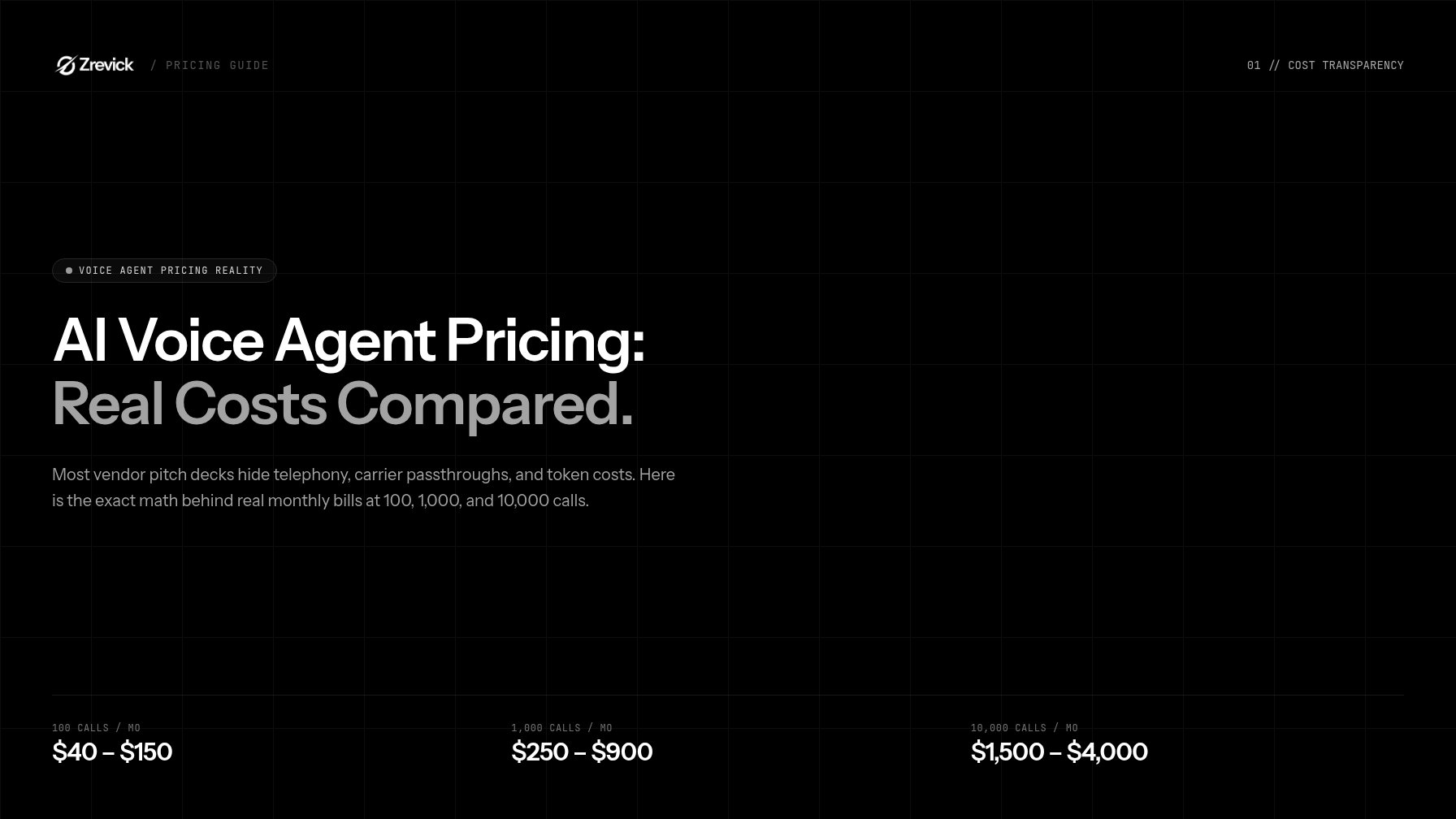
Quick answer: how much does an AI voice agent cost? Most teams pay $40–$150 per month at 100 calls, $250–$900 at 1,000 calls, and $1,500–$4,000 at 10,000 calls. Blended, that's roughly $0.15–$0.90 per call. Here's the math behind those numbers.
The Four AI Voice Agent Pricing Models
Every platform sells one of four models. The model matters as much as the rate, because it defines what a "call" costs you.
Per-minute pricing
Per-minute is where most AI voice agent pricing starts. You pay for connected call time, succeed or fail.
What does per-minute pricing include? It depends on the vendor, and this is where bills go wrong. Some platforms bundle everything into one rate: telephony, speech-to-text, the LLM, and text-to-speech. Others quote a low platform rate, then pass carrier and token costs through on top.
Typical all-in rates run $0.05–$0.15 per minute for U.S. calls. If a quote sits below that range, ask what's excluded. Something always is.
Per-call pricing
A flat fee per connected call, usually $0.10–$1.00. This model works well for short, scripted calls: appointment reminders, payment nudges, quick surveys.
It backfires on long calls. A 90-second call and a 25-minute call cost the vendor wildly different amounts. Pay the same flat fee for both, and long calls quietly subsidize the vendor.
Per-resolution pricing
You pay only when the agent completes the defined task. It sounds like the safest model, and it can be, as long as you read the fine print.
The whole deal hinges on what counts as "resolved." Some vendors count any call over 60 seconds. Others require no transfer plus a logged action in your CRM. A loose definition turns "performance pricing" into premium per-minute pricing.
Platform fees
Monthly subscriptions run from $0 on pure usage plans to $1,000+ for enterprise tiers. Watch for two extras: seat fees for dashboard users, and one-time onboarding fees. A $500 monthly platform fee is trivial at 10,000 calls. At 100 calls, it's brutal.
Realistic Monthly Bills at 100, 1,000, and 10,000 Calls
Let's model three scenarios. Assumptions: a 3-minute average call, U.S. phone numbers, and a blended usage rate of $0.08–$0.12 per minute. Rates below reflect typical published pricing as of September 2026. Confirm current numbers before you sign.
| Monthly calls | Minutes | Usage cost | Platform fee | Realistic total |
|---|---|---|---|---|
| 100 | 300 | $15–$45 | $0–$100 | $40–$150 |
| 1,000 | 3,000 | $180–$450 | $50–$500 | $250–$900 |
| 10,000 | 30,000 | $1,200–$3,000 | $200–$1,000 | $1,500–$4,000 |
Three patterns stand out:
Low volume gets taxed by fixed fees. At 100 calls, the platform fee can exceed usage. Pick a usage-only plan at this stage.
Mid volume is the sweet spot. At 1,000 calls, AI voice agent pricing works out to roughly $0.30–$0.90 per call all-in. No human alternative comes close.
High volume rewards negotiation. At 10,000+ calls, demand volume discounts. Ask for a committed annual rate. Most vendors move off list price at this tier.
Hidden Costs: What Vendors Leave Off the Landing Page
Are there hidden fees with voice agents? Almost always. This is where AI voice agent pricing gets slippery, and the cause is usually unbundling, not bad intent. Check these five line items.
1. Telephony charges
Carrier fees bill separately on many platforms. Outbound U.S. calls cost about a cent per minute through providers like Twilio. See Twilio's pricing page for current rates. Local numbers run $1–$2 each per month. Toll-free minutes cost more, and international rates vary widely.
Some "all-in" quotes exclude these. Ask directly: "Is carrier cost included in your per-minute rate, or passed through?" Get the answer in writing.
2. LLM and token usage
If the platform runs on your API keys, token costs land on your bill. Realtime audio models are billed per audio token, so a few cents per minute accumulates fast across thousands of calls. Check current model rates on OpenAI's API pricing page.
Two quiet drivers inflate usage. Long system prompts burn input tokens on every turn. And failed calls with retries burn tokens with zero outcomes.
3. Integrations
Your agent needs to reach your CRM, calendar, and database. Simple connections run through native connectors or middleware like Zapier ($20–$100 per month). Custom builds cost more. Outsourced integration work often runs $2,000–$10,000 one-time.
4. Oversight time
Someone has to review transcripts, tune prompts, and manage escalations. Budget 2–5 hours per month minimum. At a $40 loaded hourly wage, that's $80–$200 of internal cost. Real money at low volumes.
5. The small fees
Setup fees, recording storage, compliance tiers, extra seats, premium voices. Each is small. Together they can add 10–20% to a bill.
Cost per Outcome: AI Agent vs. Human Caller vs. Answering Service
Is an AI voice agent cheaper than a human caller? For routine calls at volume, yes, and by a wide margin. Here's how AI voice agent pricing stacks up against the alternatives.
Human caller. Customer service representatives earn a median of about $39,700 per year, roughly $19 an hour, according to the U.S. Bureau of Labor Statistics. Fully loaded with benefits, training, and management, a contact center seat typically costs $25–$35 per hour. A five-minute call plus after-call work costs $2–$4 in labor alone.
Answering service. Human-staffed services charge about $0.75–$2.00 per call, or roughly $200 per month for a few hundred calls. But most take messages instead of completing tasks. You still pay staff to call people back.
AI voice agent. At 1,000 calls per month, expect $0.30–$0.90 per call all-in. The agent works nights, weekends, and traffic spikes without overtime. It books, reschedules, qualifies, and logs every action.
One honest caveat: AI agents escalate. If 30% of calls transfer to humans, you pay both costs on those calls. Budget an escalation rate into every comparison, and design the agent to resolve the routine 70% on its own.
How to Forecast Your Bill Before You Commit
You don't need to guess at AI voice agent pricing. Use this formula:
Monthly cost = (calls × average minutes × blended rate) + platform fee + telephony pass-through + integrations + (oversight hours × loaded wage)
Five steps to fill it in:
- Pull last month's call logs. Real volume and duration beat any estimate. IVR or phone system data works fine.
- Run a two-week pilot on 5% of calls. Measure true duration, retry rate, and transfer rate. Voice conversations often run longer than scripted calls.
- Add a 20% buffer. Long calls, retries, and caller interruptions inflate usage.
- Apply the quoted rate, then verify what it includes. "Per minute" means nothing until you know what's bundled.
- Add fixed costs. Platform fee, phone numbers, storage, seats, and your oversight hours.
Then ask every vendor these questions in writing:
- Is the per-minute rate all-in? What's excluded?
- What counts as a "resolution" under your outcome pricing?
- Are telephony and token costs passed through, and at what markup?
- What are the seat, storage, and setup fees?
- What's the overage rate if I exceed my plan?
A vendor that answers in plain terms gives you a predictable bill. One that dodges gives you a surprise in month two.
The bottom line: AI voice agent pricing doesn't need to be a black box. Model your minutes, question every exclusion, and pilot before you commit. Teams that do pay $0.30–$0.90 per call, and they know it before the invoice arrives.
Want a second pair of eyes on a quote before you sign? Send it our way. We'll pressure-test the math against your call logs, line by line, so your first invoice never becomes a surprise.