AI SDR vs human SDR is the question founders ask right before the credit card comes out. Vendors say agents replace reps. Sales leaders say agents burn domains. Almost nobody shows the math.
This piece does. We compare what each side does well, then run fully loaded cost numbers. We also name the failure modes on both sides. "Do AI SDRs work" has an honest answer: they win at some things, fail at others, and both failures cost money.
Here's the math most founders skip.
1. AI SDR vs human SDR: where each side wins
Forget the roadmap promises. Compare what each one does today.
Where the AI SDR wins
- Volume and consistency. An agent can send thousands of touches a month and never forgets a follow-up. Humans get tired.
- Iteration speed. You can test five messaging angles across 5,000 sends in a week. A human team needs a quarter to do that.
- No ramp, no attrition. No 3–5 month onboarding. No resignation letter in month 13.
- Near-zero marginal cost. The 100th send costs about the same as the first.
- Research drafts at scale. Enrichment, account summaries, and first-draft personalization in bulk.
Where the human SDR wins
- Judgment in replies. Humans read tone. They can tell real interest from politeness, and handle curveballs without a script.
- Live conversations. Discovery calls, objection handling, and technical qualification still need a person. Agents book meetings; they rarely run them.
- Multi-threading and referrals. Mapping an org, working a champion, and asking for warm intros are relationship moves, not sequence moves.
- Brand-sensitive moments. When a deal is worth six figures, one clumsy automated email can cost more than a salary.
So in the AI SDR vs human SDR matchup, can the agent replace the rep? It can replace the sending. It rarely replaces the conversation. And one honest note: many human SDRs also run generic template sequences. The human edge is narrower than nostalgia suggests. It lives in replies, calls, and judgment, not outbox volume.
2. Fully loaded cost math: $110K+ human vs. agent subscription
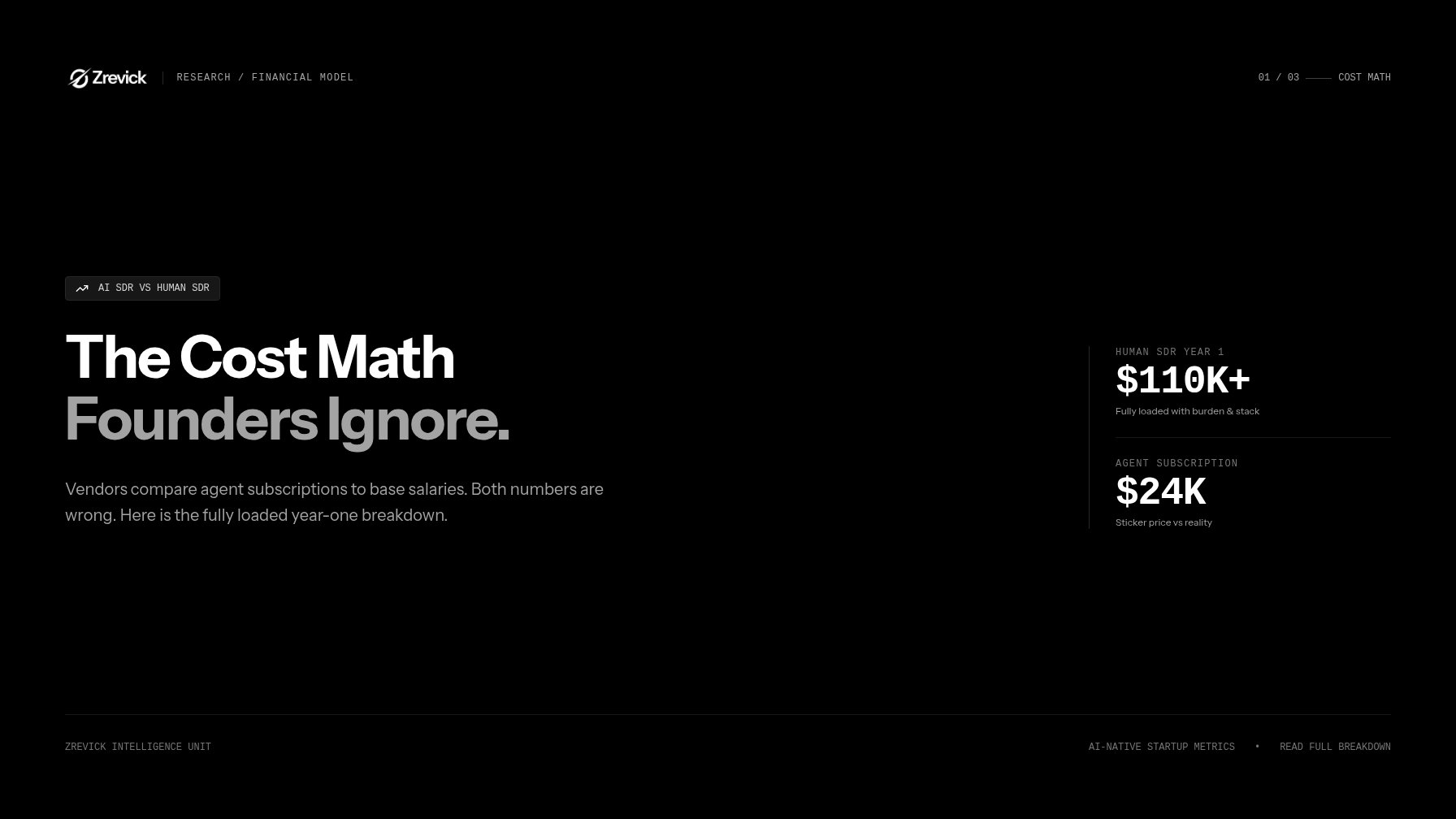
Most AI SDR vs human SDR cost comparisons stop at sticker price. Vendors compare a $2,000/month subscription to an SDR's base salary. Both numbers are wrong. Here's the honest version.
The human, fully loaded
A US mid-market SDR costs far more than salary:
| Line item | Typical year-one cost |
|---|---|
| Base salary | $60,000–$75,000 |
| Variable (OTE ~$75K–$95K) | $15,000–$25,000 |
| Payroll taxes and benefits (~25% burden) | $20,000–$25,000 |
| Tool stack per seat (engagement, data, dialer, CRM) | $6,000–$12,000 |
| Recruiting fee (~20% of OTE, one-time) | $15,000–$20,000 |
| Manager and enablement overhead | $8,000–$15,000 |
| Ramp: 3–5 months at partial quota | ~30% of year-one output |
Year one lands around $110,000–$150,000 all-in. That range tracks with The Bridge Group's long-running SDR research, which benchmarks comp, ramp, and quota across B2B teams.
Much of that spend covers non-selling work, too. Salesforce's State of Sales research puts active selling at roughly a third of a rep's week.
Now the per-meeting math. A productive SDR books 8–12 meetings a month. Call it 110–130 a year, minus no-shows.
$120,000 ÷ 110 meetings ≈ $1,000 per booked meeting.
That's the real unit price of a human-booked meeting. Adjust for no-shows and out-of-ICP accepts, and the cost per held meeting often runs $1,200–$1,500.
The agent, fully loaded
| Line item | Typical annual cost |
|---|---|
| Subscription (most tools) | $6,000–$36,000 |
| Setup: ICP definition, data, warmup | $3,000–$10,000 in cash plus internal hours |
| Extra sending domains and inboxes | $1,200–$3,600 |
| Human time supervising quality | rarely counted, always spent |
At $24,000 a year, an agent that books 10 meetings a month costs about $200 per meeting. If it books 2 a month, it costs $1,000 per meeting. Same as the human, with worse conversations.
That's the AI SDR vs human SDR cost math founders ignore. The subscription looks 5 to 10 times cheaper on paper. Output decides whether it's true.
There are also costs that never appear on a pricing page:
- Burned lists. If your total market is 3,000 accounts, a bad agent emails your best-fit prospects once, badly. You don't get a second first impression.
- Domain reputation. Spam placement is fixable, but you lose weeks finding out.
- Reply gaps. A hot reply that sits unanswered for 48 hours is a closed-lost deal no dashboard shows.
3. The hybrid model most startups land on
The AI SDR vs human SDR debate pretends there are only two options. Most teams that set out to replace an SDR with AI end up hybrid within two quarters. There are three common shapes.
Pattern 1: agent sends, human converts. The AI runs first touches and follow-ups. A human handles replies, runs discovery, and works tier-1 accounts. The human's time shifts from sending to closing.
Pattern 2: one human, several agents. A single SDR supervises inboxes across segments, edits sequences, and takes every meaningful reply. Volume roughly triples while headcount stays flat.
Pattern 3: segmented. AI works the long tail. Humans work named enterprise accounts. Cost per meeting drops in the tail; quality holds at the top.
What the hybrid model looks like day to day:
- Agent: list building, enrichment, first 2–3 touches, rescheduling, CRM updates.
- Human: intent replies, discovery calls, referrals, and message testing.
- Weekly: a human reviews a sample of AI-sent mail for tone and accuracy.
- Always: separate sending domains, warmup, and volume caps.
Rough hybrid economics: $36K in tooling plus $120K in human cost equals $156K. Output: 25–30 meetings a month instead of 10, at human-grade quality where it counts. Cost per meeting lands near $450–$500. That beats either pure model on unit economics.
4. What founders report: reply rates, meetings booked, failure modes
Public case studies are mostly vendor-produced, so treat them gently. Across founder communities, a few patterns repeat.
Which side of the AI SDR vs human SDR divide gets better reply rates?
Honest answer: parity per touch, on good lists. Cold outbound replies run in the low single digits regardless of sender. Benchmarks from Gong's research team put typical cold-sequence reply rates at a few percent. AI matches that on volume.
A human doing deep research on 60 accounts a month can beat it per account, but sends a tenth as many touches. Per dollar, the agent wins until deliverability breaks. Then it loses everything at once.
Meetings booked
Founder-reported numbers run from zero to 40+ a month. The variance comes from three things: list freshness, offer clarity, and whether replies get handled fast. Tools like Artisan and Reply publish strong numbers. Results correlate strongly with how much setup the buyer did.
AI failure modes, honestly
- Deliverability collapse. Half your sends land in spam, and you find out weeks later.
- Hallucinated personalization: "loved your recent funding round" sent to a company that never raised.
- The "stop sending me this AI junk" reply. It happens, and buyers remember who sent it.
- Compliance exposure in the EU, where GDPR makes cold B2B email legally murkier than US norms.
- The agent books the meeting, and then nobody shows up to run it.
Human failure modes, honestly
- You pay for 4 months of ramp, get 9 good months, then they leave. Median SDR tenure in most teams runs 12–18 months.
- Humans also spray-and-pray. Volume quotas produce the same junk.
- No-show rates of 30–40% on booked meetings show up in plenty of motions.
- Hiring, coaching, and pipeline inspection are real, recurring costs.
Here's the AI SDR vs human SDR difference nobody prices in: AI failures are cheap and visible in weeks. Human failures are expensive and visible in quarters. A bad agent costs you $6K and a burned list. A bad hire costs you $130K and two lost quarters. Both are survivable. Only one is usually budgeted.
5. Decision framework by deal size and ACV
The AI SDR vs human SDR decision comes down to ACV and TAM. Use them as the main filters.
| Your motion | Recommended setup |
|---|---|
| ACV under $10K, self-serve / PLG | Neither. Lifecycle email beats cold outbound here. |
| ACV $10K–$25K, SMB | AI-first outbound, AE closes. Add a human if show or close rates crater. |
| ACV $25K–$75K, mid-market | Hybrid. AI on the long tail, human on tier-1, or one human supervising agents. |
| ACV $75K+, enterprise | Human-led. AI as research assistant, not sender. Enterprise buyers punish careless outreach. |
Three more filters:
- TAM size. Small TAM makes list burn expensive. Humans on researched accounts protect it.
- Cycle complexity. Technical discovery, committees, and pilots are human territory.
- Brand sensitivity. If one bad email could reach a regulator or a marquee logo, keep humans on the trigger.
Rule of thumb: the higher the ACV and the smaller the TAM, the more a human earns their cost. The bigger the TAM and the more repeatable the pitch, the more AI wins.
So when is a human SDR still worth it? When one extra closed deal pays for the year. At a $2K ACV, no. At a $100K ACV, a $120K fully loaded SDR who moves two deals is a bargain. Run that division before you pick a side.
The verdict
The "AI SDR vs human SDR" frame is wrong. Nobody buys a sender. Everyone buys meetings that turn into pipeline.
Run the real math:
- Human: ~$1,000–$1,500 per held meeting, with judgment attached.
- Agent: ~$200–$1,000 per booked meeting, with failure risk attached.
- Hybrid: ~$450–$500 per meeting, with the failure modes of both, plus a human catch to repair most of them.
Start with your ACV and your TAM. Pick the model where the per-meeting math still works in the downside case. Then, whichever you choose, read a weekly sample of what gets sent. That's the part founders ignore until it costs them.