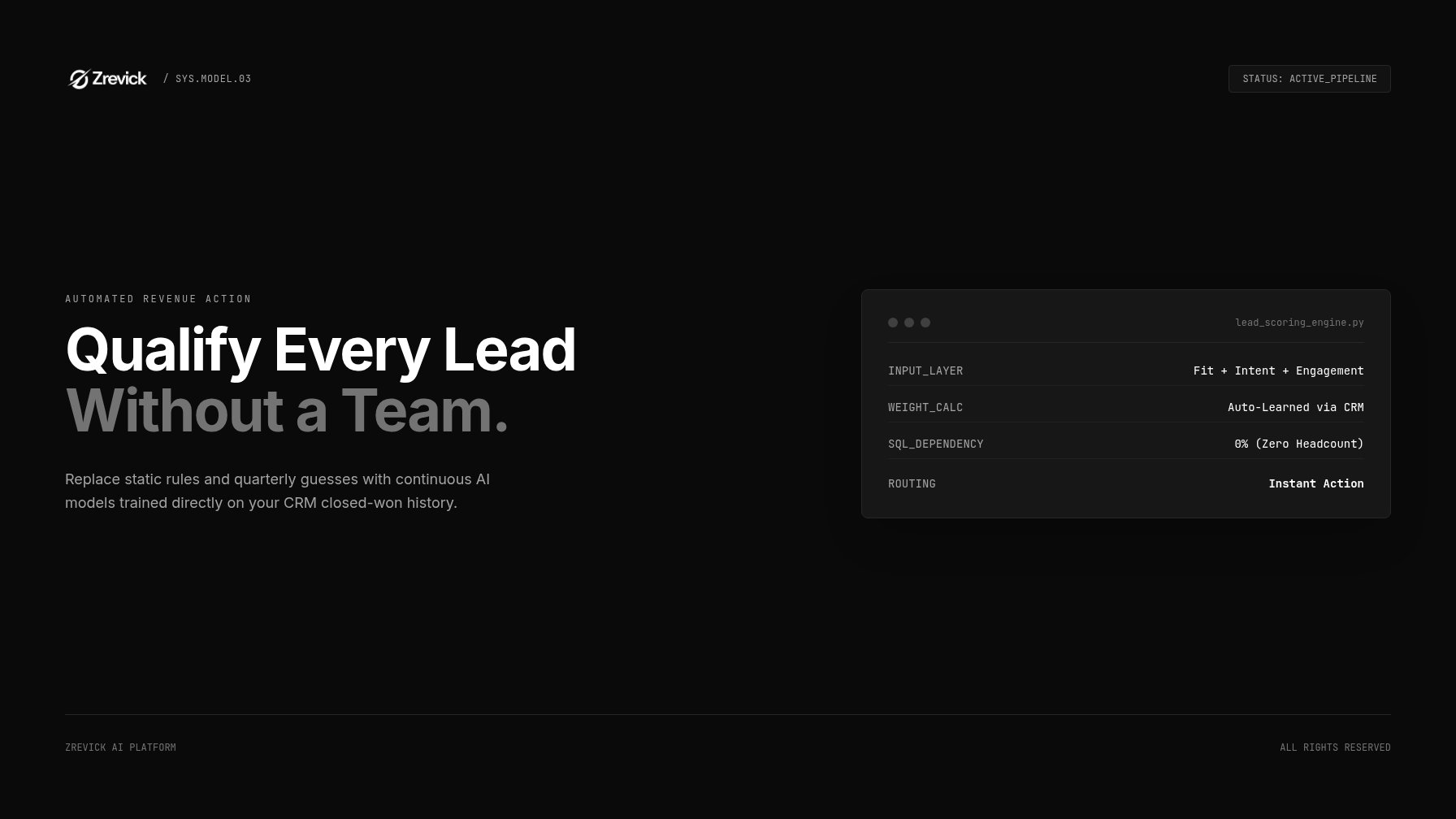
Most AI lead scoring content explains dashboards. It shows you how to build a score, then stops. The score sits in a report nobody opens, and it never routes a lead, enrolls a sequence, or books a meeting. Ever watched a rep find a hot lead three days after it went cold? That's what a passive score costs.
This piece covers the other kind: scoring that acts. You'll learn how AI lead scoring works, what data it uses, and how to launch your first model without a data team. No new headcount, no SQL. Just a score that moves leads toward revenue.
Why static lead scores rot within a quarter
Traditional scoring assigns points for attributes. VP title? +10. Two hundred employees? +15. Downloaded the ebook? +20. Someone sets those rules once, then moves on. That's the approach most lead scoring guides describe, and it works fine for a while.
The rot starts fast. Your ICP shifts as you land new customers. Product changes redefine what "engaged" means. A whitepaper that flagged buyers last quarter is noise today. A score built on guesses is a snapshot, and three months later it's a blurry one.
There's a deeper flaw, too. Point values are opinions. Nobody checked whether a VP actually closes more than a director. Nobody tested whether ebook downloads beat webinar signups. The weights were never evidence.
How is AI lead scoring different from traditional scoring?
The short answer: AI scoring learns instead of guessing.
| Traditional scoring | AI scoring | |
|---|---|---|
| Inputs | Demographics and firmographics | Fit + intent + engagement |
| Weights | Set by hand, once | Learned from closed-won and closed-lost data |
| Refresh | Manual, quarterly | Continuous, or on retrain |
| Output | A number in a field | A number tied to an action |
A static score asks, "Does this lead match our checklist?" An AI score asks, "Does this lead look like the ones that bought?" One is a guess. The other is a pattern pulled from your own outcomes.
That difference compounds. Every quarter, the model re-learns what the market just taught you.
How AI lead scoring works: ICP fit, intent signals, engagement data
How does AI lead scoring work?
The simple version: a model compares each new lead to your past winners and losers, then outputs a probability. "This lead is 23% likely to book a demo." "This one is 71% likely to reply." Training data comes from your own CRM history: closed-won, closed-lost, and everything in between.
That probability is the score. Because it updates as behavior changes, it's AI lead qualification running around the clock, not a one-time form review.
What data does AI lead scoring use?
AI lead scoring pulls from three layers, weighted by whatever actually predicted deals in your history:
1. ICP fit. Firmographic and technographic facts: industry, headcount, region, tech stack, funding stage. Does this account look like the companies that bought before? Modern ICP targeting software enriches this layer automatically, so fit updates as your customer base shifts.
2. Intent signals. Third-party research behavior: comparison-page visits, review-site activity, surging category searches. These reveal buying stage, and they happen off your site.
3. Engagement data. First-party actions: pricing-page visits, demo requests, email replies, webinar attendance. Replies to your sequences are among the highest-signal events you own.
No single layer is magic. A perfect-fit lead with zero engagement is a future account, not a today lead. An engaged lead with terrible fit is usually a tire-kicker. The model's whole job is weighing the mix.
From score to action: routing, sequence enrollment, agent handoff
Here's where most AI lead scoring posts stop, and where this one earns its keep. A score nobody acts on is decoration. Decide, in advance, what each band triggers.
Routing. Top-band leads go straight to an AE, with context attached. Mid-band leads go to an SDR queue. Low-fit leads go to nurture. The route should be automatic, not a report someone reads on Friday.
Sequence enrollment. Score bands map to tracks. High score: short, direct outreach. "Saw you checked pricing. Worth ten minutes?" Mid score: an education track, two or three touches. The band picks the track, so there's no manual triage.
Agent handoff. At a threshold, an AI agent can call, chat, or book the meeting itself. Speed decides this one. Research covered by Harvard Business Review shows the odds of qualifying a lead collapse within the first hour, and they fall fastest in the opening minutes after an inquiry. If the handoff is a task someone opens tomorrow, the score already failed.
What score threshold should trigger outreach?
There is no universal number, and anyone who hands you one is guessing. Scores are rankings, not grades. Use them relatively:
- Top decile: immediate outreach, human or AI agent. Same day, ideally same hour.
- 70th to 90th percentile: a fast sequence, two or three touches.
- Below that: nurture. Don't burn AE time here.
Set the real trigger with a backtest: pull last year's leads and score them. Find the band where conversion runs three to five times your baseline. That band is your "act now" line. Review it quarterly, because thresholds drift as the model retrains.
Building your first AI lead scoring model without a data team
You don't need a data scientist for version one. Climb this ladder until a rung works:
- Turn on CRM-native scoring. HubSpot and Salesforce both ship predictive scoring. Point it at your closed-won and closed-lost history. It's rough, but it's live in an afternoon.
- Use ICP targeting software with built-in scoring. Many tools score every new lead against your ICP on arrival. Zero modeling required.
- Build a simple model yourself. Export a few hundred labeled leads, then run a logistic regression. Scikit-learn's LogisticRegression is free and fits in one line of code. If "logistic regression" sounds scary, here's the plain version: which factors move the odds, and by how much.
A one-week build, in practice:
- Day 1: Write your ICP down. Five to seven attributes. Argue about it once, in writing.
- Day 2: Pick five to seven signals. Fit fields, plus your three best engagement events.
- Days 3 and 4: Export 200 or more historical leads with outcomes. Label them.
- Day 5: Score them. Eyeball the top 20%. Do they hold most of your winners?
- Days 6 and 7: Wire score bands to actions, per the section above.
Keep a human review loop for the first month. When the score is wrong, log why, then feed that back in. You're not building a science project. You're building a habit that runs without you.
Validation: does the score actually predict revenue?
A score is a prediction, so test it like one. Four checks:
Backtest on a holdout. Hide 20% of labeled leads from training, then score them. Does the top decile convert far more than the bottom? If yes, the model learned something real.
Measure lift. Divide top-decile conversion by your average. Three times or more is a strong model. Under two, your inputs aren't predictive yet. Change signals, not thresholds.
Check calibration. If the model says 30%, do about 30% of those leads close? Calibrated scores make thresholds meaningful. Overconfident scores burn AEs on junk.
Watch for drift. Track conversion by band, monthly. If top-band performance sags two months running, retrain. The market moved. Your model should follow.
And validate against revenue, not activity. A score that predicts demos but not deals is aimed at the wrong target. Report pipeline per band. That's the number that tells you whether the system pays for itself.
Scoring that acts, reporting that sits
AI lead scoring earns its keep at the moment of action. Route the hot ones, enroll the warm ones, and let an agent book meetings while you sleep. Start this week: turn on a small model, wire score bands to real actions, and check pipeline per band each month.
A one-person team with a working score will out-sell a big team reading dashboards. The score was never the product. What it triggers is.