AI lead generation stops feeling like a chore the moment you treat it as a system, not a tool. Most founders don't have a sales team. They have a founder sending cold email at 11pm, a spreadsheet, and five browser tabs.
That setup leaks leads at every step. This piece breaks down the closed loop: identify, rank, enrich, engage, qualify. You'll also see how to run it without stitching tools together.
The lean-team stack problem: five tools, zero operators
Ask a lean team how they find customers and you'll hear a stack list: a database like Apollo, an enrichment layer like Clay, a sequence tool, a CRM, a scoring spreadsheet. Each does one job well. None of them connect.
The connecting work is the real cost. Salesforce's State of Sales research found sellers spend roughly 70% of their time on work that isn't selling. For a solo founder, the number is worse. Every hour spent copying leads between tabs is an hour off the product.
The deeper problem is what these tools assume. Enterprise software presumes a sales ops person tuning the machine. A seed-stage team has zero operators.
So how do you generate leads without a sales team? You stop trying to replace a rep. You replace the glue work instead. Automated lead generation exists to kill the copy-paste layer, so you review decisions rather than perform tasks.
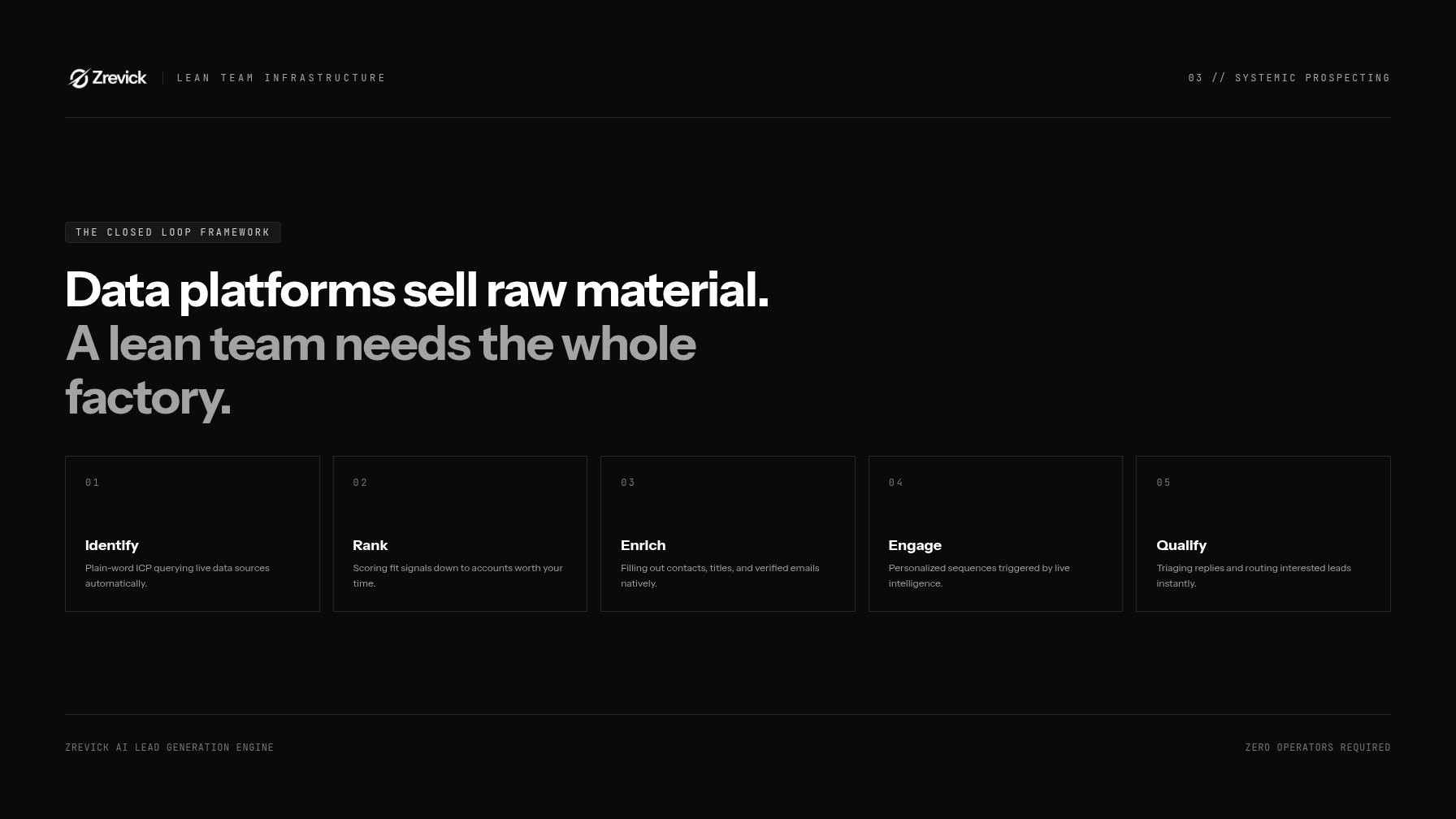
Data platforms sell you raw material. A lean team needs the whole factory.
How an AI lead generation pipeline works
The pipeline has five stages, and each one feeds the next. The goal is a loop that runs on a schedule, not on you.
1. Identification. Define your ideal customer profile in plain words. Industry, size, trigger events. The system queries live data sources and pulls the accounts that match. No rented lists, no scraping by hand.
2. Ranking. Every account gets scored against fit signals: hiring, funding, tech stack, growth patterns. The model sorts thousands of companies down to the hundred worth your time.
3. Enrichment. Each account gets filled out with contacts, titles, verified emails, and recent news. This used to be a separate purchase and a separate job. In a closed loop, it just happens.
4. Engagement. Personalized sequences launch from what enrichment found. The AI references their Series A, not "Hi {FirstName}."
5. Qualification. Replies get triaged. Interested leads route to your calendar. Dead ends get logged. The pipeline tells you who to talk to, not just who exists.
Every stage is a standalone product today. The real innovation is closing the loop so they share context. When ranking learns from what engagement discovered, your list gets sharper every week. That's the gap between an AI lead generation software bundle and a true system.
Where AI beats manual prospecting, and where it doesn't
Does AI lead generation work? Yes, inside its lane. The lane has edges, so here's the honest map.
Where AI wins:
- Breadth. It can review every company matching your ICP, not just the ones you stumble across.
- Speed. A week of list-building happens in an afternoon.
- Consistency. It follows up every single time. Humans forget.
- Learning. It notices which replies convert and shifts volume toward those segments.
Where AI loses:
- Strategy. It can't tell you which market to attack. That call stays human.
- Complex deals. Big enterprise motions still need relationship work.
- Edge cases. Unusual companies confuse pattern matching.
- Judgment. "Do we chase this whale?" is a founder decision.
HubSpot's sales research ranks prospecting among the toughest parts of the job for reps. That's exactly where AI helps. It takes the volume grind and hands you a shortlist. Think of an AI prospecting tool as a scout, not a closer. It finds and filters. You still sell.
Build your first AI lead generation list, step by step
How do you build a lead list with AI? Start small and let the loop learn.
Step 1: Write your ICP as one sentence. "US B2B SaaS, 10–50 employees, raised a seed in the last year." Plain language beats a twelve-field filter.
Step 2: Set three to five disqualifiers. These save more time than qualifiers. No agencies, no pre-revenue, no marketplaces.
Step 3: Pick your signals. Funding, hiring sprees, tech-stack changes. Signals are what make ranking useful.
Step 4: Pull and rank a first batch. Review the top 50 by hand. You're training your eye and the model at once.
Step 5: Enrich, verify, engage. Verify emails before sending anything, because bounces wreck your sending domain. Then launch short, specific sequences.
Step 6: Read replies daily at first. Mark good and bad leads. Feed that back into ranking.
Step 7: Raise volume only when quality holds. Scaling a dumb loop just produces more bad leads faster.
Zrevick runs these stages as one system. If you're assembling your own stack, keep the handoffs tight. Most DIY pipelines fail in the gaps between tools, not in the tools themselves.
Seed-stage benchmarks: what a working pipeline produces
What should AI lead generation produce in your first 90 days? Here are sane marks for a founder-run pipeline with a decent ICP.
Days 1–30: calibration. First list built, first sends out. Expect a 2–5% reply rate, mostly rejections. You're tuning the ICP. The real win is list fit, not meetings.
Days 31–60: signal. Reply rates edge toward 5–8%. First meetings book. One to three per week is healthy. Enrichment data now trains ranking, so list quality climbs.
Days 61–90: throughput. The pipeline produces 5–10 qualified conversations a month on under two hours of your week. McKinsey's research on generative AI puts sales and marketing among the top functions for AI value. This is what that looks like at seed scale.
Benchmarks shift with deal size and market. But here's the honest test. If you're still hand-copying leads between tabs at day 90, the pipeline isn't running. You're the integration layer, and integrations burn out.
AI lead generation isn't a database, and it isn't magic. It's a closed system: identify, rank, enrich, engage, qualify. Build the loop once and it compounds while you build the company.
The founder sending cold email at 11pm doesn't need a bigger spreadsheet. They need a system that runs on a schedule instead of on them. If you want to see that loop running against your own ICP, that's exactly what Zrevick builds. The whole factory, not just the data.